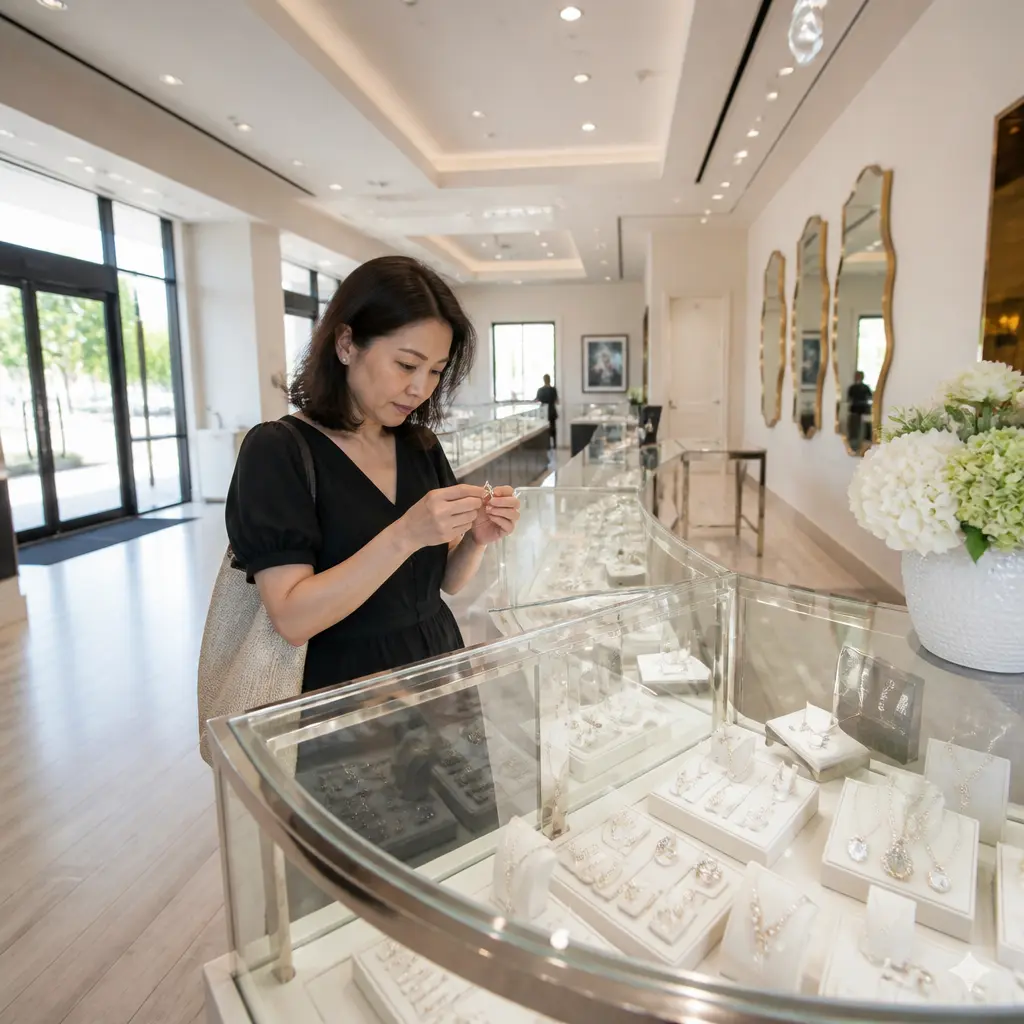

Pearl jewelry is jewelry made with natural or cultured pearls, and its enduring appeal comes from a rare combination of luminosity, cultural history, and styling flexibility. Classic pearl looks still feel fresh when proportion, layering, color, and setting are updated for contemporary wardrobes rather than treated as fixed formalwear. The Gemological Institute of America (GIA) evaluates pearls through six principal quality factors—size, shape, color, luster, surface quality, and nacre quality—while the Smithsonian Institution traces pearls across thousands of years of adornment. From a single strand and pearl studs to mixed-metal pendants, baroque shapes, and asymmetric earrings, the modern pearl wardrobe demonstrates why this organic gem remains relevant.
Pearl jewelry: classic versatility
The entity-attribute pairing “pearl jewelry: classic versatility” describes pearl adornment that preserves recognizable traditional qualities—soft luster, refined scale, and visual simplicity—while adapting to different clothing, occasions, and personal styles. Fashion historian Valerie Steele has described the little black dress as a durable fashion idea because it can be repeatedly reinterpreted; pearls function similarly as an accessory category. Their identity remains stable, but their settings, lengths, colors, and combinations change with the wearer.
Pearls are also distinctive because they are organic gems formed inside mollusks rather than minerals produced through geological crystallization. GIA explains that nearly all pearls sold commercially today are cultured, meaning people initiate and support the formation process while the mollusk deposits nacre around an implanted nucleus or tissue. This distinction gives shoppers a practical way to understand the category: natural pearls are exceptionally scarce, while cultured freshwater, Akoya, Tahitian, and South Sea pearls provide the variety seen in contemporary jewelry.
Pearl studs: the everyday classic
Pearl studs are single pearls mounted close to the earlobe, usually with a simple metal post or bezel. They are the most direct expression of classic pearl styling because their clean outline works with tailoring, knitwear, denim, and evening clothing alike. A pair in the approximately 6-to-8-millimeter range often reads as polished without overwhelming the face, while smaller pearls create a quieter effect and larger pearls become a deliberate statement.
Their continued relevance comes from low styling friction. Studs can be worn alone for a restrained look, paired with small hoops for a graduated ear arrangement, or mixed with yellow, white, or rose gold. GIA’s quality framework is useful here: luster usually has a stronger visual impact than perfect roundness, so a slightly irregular pearl with sharp reflections can look more lively than a perfectly symmetrical but dull example.
Pearl strands: formal heritage with modern proportions
A pearl strand is a sequence of pearls connected by thread, often finished with a clasp. The traditional single strand remains a shorthand for elegance, but its styling can be modernized through length and placement. A shorter collar sits high on the neck; a princess-length strand generally falls near the collarbone; and longer opera or rope lengths can be doubled, knotted, or worn asymmetrically.
The freshest interpretation is often not a different pearl but a different proportion. Wearing a strand over a crew-neck sweater, beneath an open shirt collar, or alongside a fine chain changes its social message from ceremonial to relaxed. A useful visual comparison chart would place strand lengths beside neckline types, showing how the same pearl necklace shifts from traditional to casual according to scale and layering.
Pearl color and shape: expressive individuality
Pearl color and shape are attributes that move pearl jewelry away from uniform tradition and toward personal expression. Although white and cream pearls remain the most familiar, natural body colors and overtones can include silver, pink, green, blue, gray, yellow, and peacock tones. Shape categories commonly include round, near-round, button, drop, oval, circled, and baroque. These categories are not merely descriptive: they influence how a piece catches light, frames the face, and communicates formality.
White and cream pearls: quiet polish
White and cream pearls are the classic neutral version of the category. They complement black, navy, gray, denim, camel, and white clothing without introducing a strong competing hue. Akoya pearls are especially associated with white to cream body colors and bright luster, while freshwater pearls offer broad variation in shape and undertone.
A current way to wear white pearls is to reduce the amount of visual symmetry. Instead of matching necklace, bracelet, and earrings, a wearer might choose white studs with a silver chain or a single pendant with an unbuttoned shirt. The result retains the light-reflective quality associated with classic pearls but avoids an overly coordinated appearance.
Dark and colored pearls: contemporary contrast
Dark and colored pearls introduce contrast while retaining the material’s organic glow. Tahitian cultured pearls are known for gray, green, blue, and peacock overtones, and South Sea pearls may appear white, silver, cream, or golden. Color should be assessed under neutral lighting because surrounding fabrics and warm indoor light can alter perception.
These pearls work particularly well with minimalist clothing. A gray or peacock pearl pendant against a white shirt, black knit, or charcoal jacket creates a focal point without requiring an elaborate setting. The broader styling principle is simple: when the pearl has strong color or overtone, keep the surrounding design clean so the surface remains visible.
Baroque pearls: irregularity as a design feature
Baroque pearls are visibly non-round pearls with organic contours. Their irregularity is not automatically a defect; it is the defining design attribute. Baroque freshwater pearls can be elongated, flattened, sculptural, or softly rippled, making them useful for oversized pendants, sculptural earrings, and long strands.
Their popularity reflects a wider movement toward individuality and visible craftsmanship. A baroque pearl pendant worn on a simple cord or a pair of mismatched baroque earrings can feel less formal than a round pearl set in a traditional mount. GIA’s emphasis on evaluating luster and surface quality remains important: irregular shape may be desirable, but weak luster or distracting surface damage can still reduce visual appeal.
Pearl layering: updated proportion and texture
Pearl layering is the combination of two or more pearl pieces, or of pearls with chains, metals, beads, and other materials. It updates the classic strand by introducing varied lengths, textures, and visual weight. The technique is especially effective because pearls are reflective but not aggressively bright, allowing them to sit beside gold, silver, leather, enamel, or colored gemstones.
Mixed-length necklaces: from inherited to intentional
Mixed-length necklaces use separate chains or strands positioned at different points on the chest. One arrangement might combine a short pearl choker, a mid-length pendant, and a longer delicate chain. The spacing prevents the pieces from merging into one dense band and creates a deliberate vertical line.
For a balanced result, vary at least one feature—length, pearl size, metal color, or chain texture—while repeating another. For example, white pearls can unify yellow-gold and silver pieces, while a consistent metal can connect pearls in different shapes. This approach makes an heirloom strand compatible with contemporary layering rather than reserving it for a suit or evening dress.
Pearls with casual clothing: contrast without costume
Pearls with casual clothing create relevance through contrast. A single strand over a T-shirt, pearl earrings with a denim jacket, or a pendant over a ribbed sweater places a traditionally refined material beside informal textures. The contrast works best when the outfit has one clear anchor, such as a simple neckline, clean sneakers, or an uncomplicated jacket.
The goal is not to disguise the pearl’s elegance but to change its context. Fashion exhibitions at The Metropolitan Museum of Art have repeatedly shown how familiar garments and accessories acquire new meanings when paired with different materials and silhouettes. The same principle applies to everyday styling: context, not age, determines whether a pearl looks current.
Pearl craftsmanship: quality, care, and longevity
Pearl craftsmanship includes the quality of the pearls, the security of the setting, the durability of the clasp, and the maintenance of the strand or mounting. Because pearls are made primarily of nacre, they are softer and more vulnerable to abrasion, chemicals, and heat than many mineral gemstones. GIA places pearl hardness at approximately 2.5 to 4.5 on the Mohs scale, which explains why careful storage matters.
Luster and nacre: the visual foundation
Luster is the sharpness and intensity of reflected light from a pearl’s surface, while nacre is the layered material deposited by the mollusk. High luster can make a pearl appear dimensional and radiant; thin or uneven nacre may create a chalky appearance or reveal the nucleus more readily. These attributes often matter more to the overall impression than a small difference in diameter.
Shoppers comparing similar pieces should examine reflections rather than relying only on color names. A strong reflection should appear crisp, and the surface should be viewed from multiple angles. Matching is also significant in a pair or strand: differences in size, overtone, and luster may be attractive in an intentionally eclectic piece but distracting in a traditional matched set.
Care routines: preserving a wearable classic
Pearl care means putting jewelry on after cosmetics, perfume, hairspray, and skincare have dried; wiping pearls with a soft cloth after wear; and storing them separately from harder jewelry. GIA recommends avoiding ultrasonic and steam cleaners for pearls because heat, vibration, or moisture can damage nacre or weaken the adhesive used in some settings.
Strands deserve additional attention. A frequently worn necklace should be inspected for fraying thread and checked by a professional when the knots loosen or the clasp becomes unreliable. Knots between pearls can limit loss if the thread breaks, making restringing an important maintenance practice rather than an occasional luxury.
Pearl heritage: why the classic keeps evolving
Pearl heritage is the historical and cultural meaning attached to pearls, including associations with status, ceremony, femininity, mourning, spirituality, and wealth. Ancient Roman accounts connected pearls with elite display, while European royal portraits helped establish the pearl as a symbol of rank. In the twentieth century, public figures such as Coco Chanel and Jacqueline Kennedy helped shift pearls between couture, professional dress, and personal signature.
Cultured pearl production also changed access to the category. Kokichi Mikimoto is widely credited with producing the first successful cultured Akoya pearl in Japan in 1893, according to the Mikimoto company’s historical record. The development helped move pearls from an extremely scarce natural treasure toward a broader jewelry market, while still preserving their associations with refinement.
Heirloom pearls: continuity through reinterpretation
Heirloom pearls are inherited or long-owned pieces whose value includes memory and family history. Their relevance does not depend on leaving them unchanged. A jeweler may shorten a strand, replace an outdated clasp, reset a single pearl as a pendant, or combine inherited pearls with a modern chain.
This approach treats classic jewelry as adaptable material rather than a museum object. Before altering an heirloom, document its condition, confirm whether the pearls are natural or cultured, and obtain an appraisal if insurance or family valuation matters. A redesign should preserve the qualities that make the piece meaningful while improving how often it can be worn.
Responsible purchasing: value beyond appearance
Responsible pearl purchasing considers origin claims, farming practices, durability, repairability, and the transparency of the seller. Cultured pearls are not automatically impact-free: aquaculture can involve ecological benefits and environmental pressures that vary by species, location, feed practices, labor conditions, and farm management.
Buyers can ask whether the seller identifies the pearl type, provides meaningful treatment information, explains the metal’s sourcing, and offers restringing or repair services. Choosing a durable piece and wearing it for many years is also a practical sustainability strategy. The strongest classic look is not necessarily the newest purchase; it is often the piece that remains useful across wardrobes and generations.
Conclusion: pearl jewelry with a current point of view
Pearl jewelry remains fresh because its defining attributes—luster, organic formation, and refined simplicity—can support many visual languages. Pearl studs offer everyday versatility; strands gain new energy through proportion and layering; colored and baroque pearls provide individuality; and careful craftsmanship protects both appearance and longevity. Historical continuity, from ancient adornment to cultured pearl production and modern heirloom redesign, explains why the category continues to evolve rather than disappear.
To build a relevant pearl wardrobe, begin with one versatile piece, compare luster and surface quality in neutral light, experiment with mixed lengths or casual clothing, and maintain the jewelry properly. Further reading from GIA, the Smithsonian Institution, The Metropolitan Museum of Art, and reputable pearl specialists can help distinguish pearl types, understand quality factors, and make more informed purchasing decisions.
Sources: Gemological Institute of America, Pearl Quality Factors, https://www.gia.edu/pearl-quality-factor; Gemological Institute of America, Pearl Care and Cleaning Guide, https://www.gia.edu/pearl-care-cleaning; Smithsonian Institution, Pearls, https://ocean.si.edu/ecosystems/coral-reefs/pearls; The Metropolitan Museum of Art, Heilbrunn Timeline of Art History, https://www.metmuseum.org/toah/; Mikimoto, History of Mikimoto, https://www.mikimoto.com/us_en/about-us/history