Delicate pearl earrings bring a soft, reflective accent to natural getting-ready light, making them especially effective for bridal portraits, morning ceremonies, and relaxed dressing areas. As jewelry made with pearls—organic gemstones formed inside mollusks—these earrings combine low visual weight with gentle luster. Small studs, slim drops, pearl huggies, and minimalist hoops each suit different face shapes and hairstyles, while pearl hardness, metal choice, pearl size, and the color temperature of daylight influence comfort, durability, and how the earrings appear in photographs.
Delicate Pearl Earrings Define Natural-Light Readiness
The entity-attribute pairing “delicate pearl earrings” describes pearl earrings designed with a restrained scale, uncomplicated silhouette, and light-reflective finish. The Gemological Institute of America defines a pearl as an organic gem produced by a living mollusk, and its educational materials identify pearl hardness as approximately 2.5 to 4.5 on the Mohs scale. That relative softness makes careful styling and storage important, particularly during a busy getting-ready routine.
The attribute “delicate” generally refers to small pearls, fine chains, narrow settings, short drops, or understated metalwork rather than to a single technical jewelry standard. In natural window light, these characteristics help the earrings add brightness without creating a visually heavy spot beside the face. The result is a versatile accessory that can complement bare skin, satin robes, lace, silk, or a simple white shirt.
Pearl studs: the most understated hyponym
Pearl studs are earrings in which a single pearl sits close to the earlobe, usually on a post and friction back. They are the most restrained form of delicate pearl earrings and are particularly practical for hair-and-makeup photographs because they rarely catch on brushes, combs, veils, or clothing.
Small white or cream studs can reflect soft daylight toward the face without competing with eye makeup. A pearl diameter of about 5 to 7 millimeters is commonly modest enough for an understated look while remaining visible in close-up portraits. Buyers should check whether the pearl is freshwater, Akoya, cultured South Sea, or imitation, since origin and production method affect price, surface appearance, and shape.
Pearl drops and threaders: movement with lightness
Pearl drop earrings suspend one pearl or a small cluster below the lobe, while threader earrings use a fine chain that passes through the piercing. These forms introduce movement and can lengthen the visual line of the face, but shorter drops are usually better suited to natural getting-ready light because they remain visible without overwhelming a loose hairstyle.
A drop measuring roughly 10 to 25 millimeters below the lobe can provide graceful motion for portraits. For practical wear, examine the connection between the pearl and the setting, especially when the earring includes a thin jump ring or delicate chain. The American Gem Society advises protecting pearls from chemicals and abrasion, so hairspray, perfume, and cosmetics should be applied before the earrings are put on.
Pearl huggies and minimalist hoops: a modern variation
Pearl huggies are small hoops that sit closely around the earlobe, often with a pearl attached to the front or base. Minimalist pearl hoops combine the circular outline of a hoop with the softer surface reflection of a pearl. They are useful for someone who wants a contemporary accessory rather than a traditional matched stud.
Because hoop profiles can create stronger lines than studs, a thin gold, silver, or platinum-colored hoop generally works best beside a window. The choice of metal also changes the perceived color of the pearl: yellow gold can emphasize cream and warmth, while white metals can make white or rose-overtoned pearls appear cooler and brighter.
Natural Getting-Ready Light Reveals Pearl Luster
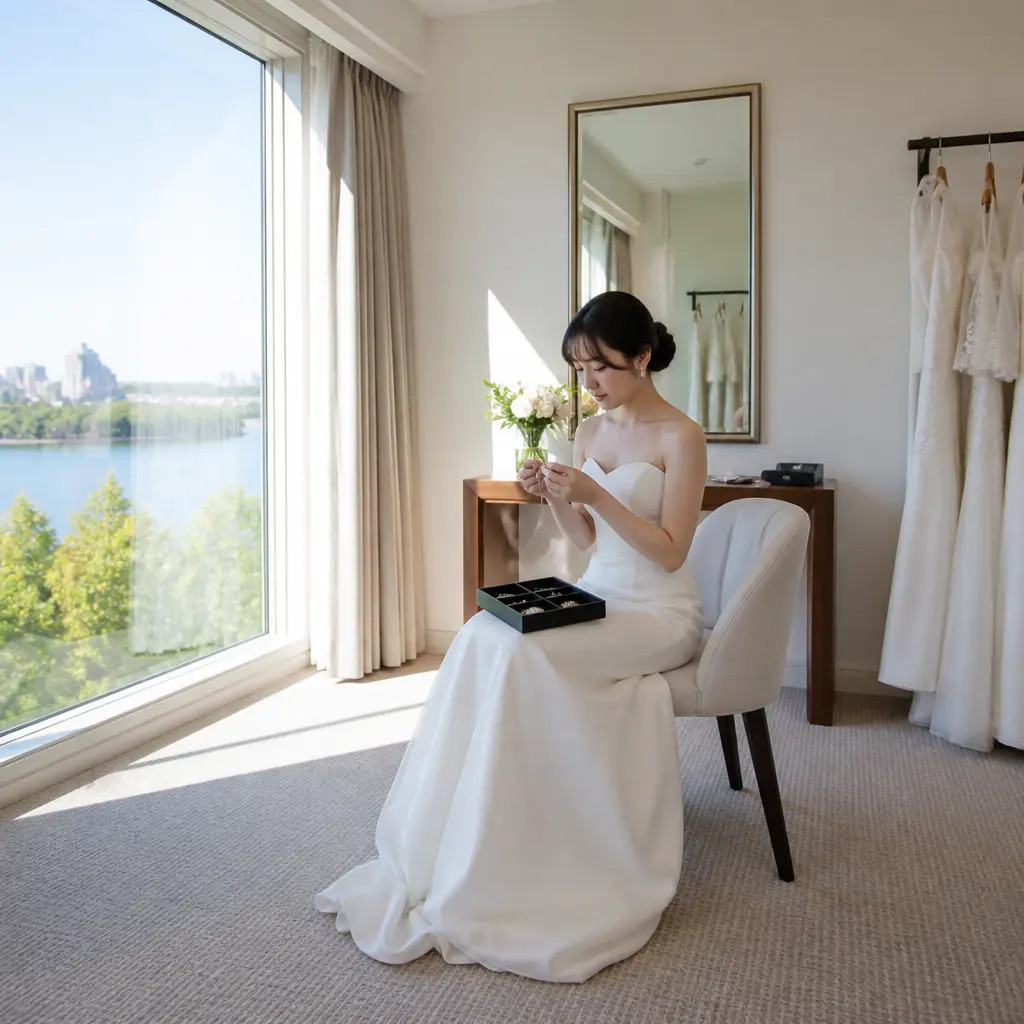
Natural getting-ready light is daylight entering through windows, doors, or open-air spaces before or during dressing and preparation. Unlike a small direct flash, window light is broad and diffuse, so it tends to reveal the pearl’s orient, surface quality, and reflected highlights gradually. The National Oceanic and Atmospheric Administration describes daylight as variable in color and intensity, which means the same earrings may look warmer in early morning light and cooler under an overcast sky.
Window direction and diffusion
A north-facing window in the Northern Hemisphere is traditionally valued by photographers for relatively consistent, indirect illumination, while an east-facing window can provide warmer morning light and a west-facing window can produce stronger afternoon contrast. Sheer curtains, translucent blinds, and a few feet of distance from the glass diffuse highlights and reduce harsh reflections on the pearl surface.
For a getting-ready portrait, place the subject at an angle of approximately 45 to 90 degrees from the window rather than directly against it. This arrangement lets the pearl receive enough light to show luster while preserving facial dimension. A simple comparison chart can be useful: direct sun creates the strongest contrast, overcast daylight creates the softest contrast, and filtered window light generally offers the most controllable balance for pearl jewelry.
Color temperature and pearl appearance
Color temperature describes the apparent warmth or coolness of light and is measured in kelvins. Daylight can vary broadly, but photographic daylight settings commonly use approximately 5,500 to 6,500 kelvins. Warmer light can make ivory, cream, peach, and golden pearls look richer, whereas cooler light can emphasize silver, pink, blue, or white overtones.
The U.S. Department of Energy notes that color rendering affects how accurately surfaces appear under a light source. Although natural daylight is not a controlled studio standard, its broad spectrum usually makes it a reliable reference for judging whether a pearl complements a dress, robe, or makeup palette. Compare the earrings beside the intended clothing in the actual preparation room instead of relying only on store lighting.
Pearl Quality Attributes Support Delicate Styling
Pearl quality is assessed through attributes such as luster, surface, shape, color, size, nacre, and matching. The Gemological Institute of America identifies luster as the quality and intensity of light reflected from a pearl’s surface; strong luster creates sharp, bright reflections, while weaker luster appears more muted. In natural window light, luster is often more noticeable than a dramatic setting, which is why a simple earring can look polished without being ornate.
Luster and surface cleanliness
Luster is the most important visual attribute when delicate pearl earrings are intended for close portraits. Look for a reflection that appears bright and relatively defined rather than cloudy. Minor natural marks are common, especially in freshwater pearls, but deep pits, cracks, chalky patches, or peeling nacre may become more visible in side light.
Pearls should be wiped gently with a soft, damp cloth after wear and allowed to dry before storage. The American Gem Society recommends avoiding ultrasonic cleaners, steam cleaners, abrasive cloths, and household chemicals because pearls can be damaged by heat, solvents, and abrasion.
Pearl size, shape, and color
Smaller pearls, typically under 7 millimeters for studs, support a delicate proportion, while larger pearls create a more formal focal point. Round pearls offer symmetry and a classic appearance; oval, button, drop, and baroque shapes introduce variation. A baroque pearl is an intentionally irregular pearl, not necessarily a lower-quality pearl, and its organic outline can suit relaxed or modern styling.
White and cream pearls are the easiest to coordinate with bridal clothing, but pink, lavender, peach, gray, and black tones can complement skin undertones and colored garments. When purchasing a pair, inspect matching carefully. GIA notes that matching involves comparing pearls for consistency in color, size, shape, luster, and surface quality, all of which influence how balanced the earrings look together.
Delicate Pearl Earrings Fit Practical Getting-Ready Routines
Comfort, closures, and metal choice
Comfort depends on total weight, post length, backing security, and sensitivity to the earring metal. Push backs are convenient for studs, screw backs offer additional security, and lever backs can be useful for small drops. For sensitive ears, look for nickel-free options and confirm whether the post is solid gold, sterling silver, platinum, titanium, or plated metal.
A lightweight pair is especially helpful during hair styling, makeup application, travel, and long ceremonies. Before an event, wear the earrings for at least an hour and test movements such as turning the head, putting on a robe, and placing hair behind the ear. This practical test can reveal pressure or looseness before photographs begin.
Styling with hair, makeup, and clothing
Pearl studs work with low buns, ponytails, short hair, and loose waves because they remain close to the lobe. Short pearl drops add visible movement to pulled-back hair, while huggies and hoops support a cleaner, contemporary look. If the outfit already includes lace, beading, crystals, or a detailed neckline, a single pearl is often more cohesive than a large cluster.
Apply skincare, foundation, hairspray, fragrance, and makeup before inserting the earrings. This sequence follows the care principle that cosmetics and chemicals should not remain on pearl surfaces. It also reduces the chance of snagging the earrings while working around the face and hair.
Buying checklist for natural-light photography
- Choose a silhouette—stud, short drop, huggie, or slim hoop—that matches the hairstyle and neckline.
- Check luster in indirect daylight, not only under bright retail spotlights.
- Compare both earrings for size, color, shape, surface, and brightness.
- Confirm pearl type, metal content, earring dimensions, and closure style.
- Ask whether the pearls are cultured or imitation and whether treatments are disclosed.
- Keep the earrings away from perfume, hairspray, cosmetics, chlorine, and abrasive jewelry.
- Store pearls separately in a soft pouch rather than in a hard compartment with diamonds or other gemstones.
Conclusion: Choose Pearls That Cooperate With Light
Delicate pearl earrings are defined by restrained scale, simple construction, and an ability to reflect light softly near the face. Pearl studs provide the quietest hyponym, short drops add movement, and huggies or minimalist hoops offer a contemporary alternative. Natural window light makes luster, color, surface, and matching easier to evaluate, while pearl care remains essential because the gemstone ranks only about 2.5 to 4.5 on the Mohs hardness scale.
For the most reliable choice, compare the earrings with the intended outfit in the actual getting-ready space, favor diffuse daylight, and test comfort before the event. Further reading from the Gemological Institute of America and the American Gem Society can help buyers understand pearl grading, treatments, cleaning, and long-term storage before making a purchase.
Sources: Gemological Institute of America, Pearl Quality Factors, https://www.gia.edu/pearl-quality-factor; Gemological Institute of America, Pearl Care and Cleaning, https://www.gia.edu/pearl-care-cleaning; American Gem Society, Pearl Buying Guide, https://www.americangemsociety.org/buying-guide/pearl-buying-guide/; American Gem Society, How to Clean and Care for Pearls, https://www.americangemsociety.org/articles/how-to-clean-and-care-for-pearls/; National Oceanic and Atmospheric Administration, Solar Radiation and Daylight, https://www.noaa.gov/education/resource-collections/weather-atmosphere/solar-radiation; U.S. Department of Energy, Lighting Choices to Save You Money, https://www.energy.gov/energysaver/lighting-choices-save-you-money