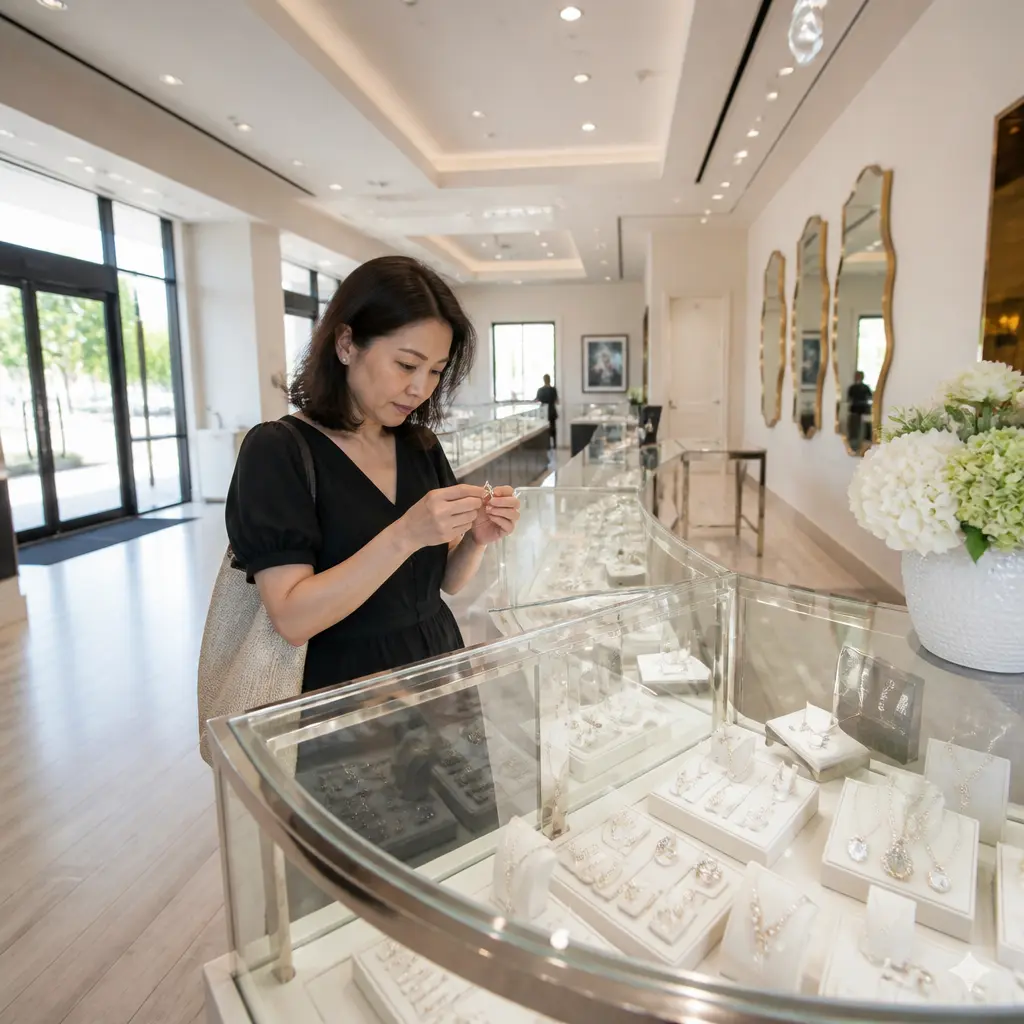

Natural pearls and cultured pearls are both genuine pearls formed when nacre, the iridescent calcium-carbonate material produced by a mollusk, builds around an irritant or implanted nucleus. The decisive real-life difference is origin: a natural pearl develops without deliberate human insertion, while a cultured pearl develops after people initiate the process. The Gemological Institute of America states that virtually all pearls sold today are cultured, making origin, not simply beauty, the central distinction for buyers. Natural pearls are generally rarer and can command higher prices, whereas cultured pearls offer wider availability, more consistent sizes, and lower average cost. Shape, surface quality, nacre thickness, luster, laboratory testing, treatment, and provenance all affect how the two categories look and perform in jewelry.
Pearl Origin Defines the Difference Between Natural and Cultured Pearls
Pearl origin is the attribute that identifies whether a pearl formed spontaneously in nature or through human-assisted cultivation. The CIBJO Blue Books define a natural pearl as a pearl formed entirely by nature without human intervention, while a cultured pearl is formed through human intervention that causes a mollusk to produce nacre around an implanted nucleus, tissue, or other material. Both are authentic biological products; “cultured” does not mean imitation.
This distinction matters because appearance alone is unreliable. A high-quality cultured pearl can be more lustrous, rounder, and visually cleaner than an average natural pearl. Conversely, a natural pearl can be irregular, dull, blemished, or quite small. The American Gem Society and GIA both emphasize that reliable identification normally requires gemological testing rather than visual inspection alone.
Natural Pearls Form Without Deliberate Human Intervention
A natural pearl forms when a foreign stimulus becomes embedded inside a mollusk and the animal responds by depositing concentric layers of nacre. The trigger may be a parasite, tissue injury, or another naturally occurring irritant. The result is unpredictable: natural pearls may be round, button-shaped, baroque, elongated, or irregular, depending on the mollusk and the location of formation.
Natural saltwater pearls historically came from pearl oysters in regions such as the Persian Gulf, the Gulf of Mannar, the Red Sea, and the waters around Australia and Japan. Overharvesting and improvements in pearl cultivation sharply reduced the commercial importance of wild pearl fisheries during the twentieth century. Today, documented natural pearls are uncommon in ordinary retail jewelry, and credible provenance or laboratory confirmation is especially important.
Cultured Pearls Begin With Managed Aquaculture
A cultured pearl begins when technicians place a nucleus, mantle tissue, or both inside a living mollusk. The animal is then returned to water, where it covers the inserted material with nacre. The cultured category includes saltwater akoya, South Sea, and Tahitian pearls, as well as freshwater pearls produced mainly by mussels.
Cultivation allows producers to influence species, growing conditions, harvest timing, and, in some cases, pearl shape. This does not make the pearl synthetic: the nacre is still produced by a living mollusk. GIA reports that cultured pearls account for virtually all pearls commonly encountered in modern jewelry, which explains why the practical buying question is usually not “real or fake?” but “what type of real pearl is it, and how was it formed?”
Appearance Shows Similarities, but Nacre Structure Reveals Pearl Quality
Nacre structure is the material attribute that gives both natural and cultured pearls their characteristic luster and orient. Nacre consists primarily of microscopic aragonite platelets held together by organic material. Light reflecting through and between these layers creates the glow that distinguishes a pearl from a glass, plastic, or shell bead imitation.
Because both categories contain nacre, they can look remarkably similar in real life. Color, shape, size, luster, surface cleanliness, and matching quality are useful for describing a pearl, but none of these characteristics alone proves natural origin. A polished photograph or retail display also cannot reliably show whether a cultured pearl has a thick nacre coating or a thin nacre layer over a bead nucleus.
Luster and Orient Are Shared Visual Characteristics
Luster describes the sharpness and intensity of reflections from a pearl’s surface, while orient refers to shifting rainbow-like colors caused by light interacting with its layered structure. Strong luster is desirable in both natural and cultured pearls. In practice, a well-grown cultured pearl may display exceptionally strong luster because producers select healthy mollusks and carefully manage cultivation conditions.
Surface quality is a separate consideration. Blemishes such as pits, wrinkles, spots, and abrasions can occur in either origin category. A pearl with minor surface marks but excellent luster may be more attractive than a very clean pearl with a chalky or weak reflection. Buyers should therefore assess luster before assuming that rarity automatically means visual superiority.
Shape and Size Reflect Species and Cultivation Method
Natural pearls are often irregular because their formation site and growth conditions cannot be controlled. Cultured pearls also include baroque and semi-baroque forms, but cultivation makes it possible to produce larger quantities of round, oval, button, drop, and other commercially useful shapes.
Saltwater bead-nucleated pearls commonly develop around a spherical nucleus, while many freshwater pearls are tissue-nucleated and may be composed almost entirely of nacre. This difference can affect weight, shape, durability, and the way a pearl responds to X-ray examination. Size is not a simple indicator of natural origin: large natural pearls are rare, but large cultured South Sea and freshwater pearls are established products of modern aquaculture.
Gemological Testing Separates Natural-Pearl Origin From Cultured-Pearl Origin
Gemological testing is the attribute that converts a visual opinion into an origin assessment. Laboratories examine a pearl’s internal structure using methods such as X-ray radiography, X-ray computed tomography, spectroscopy, microscopy, and, when appropriate, examination of a drilled or damaged area. The objective is to identify evidence of a bead nucleus, concentric growth structures, or a different internal pattern associated with natural formation.
A laboratory report may identify a pearl as natural or cultured and may also describe whether it is saltwater or freshwater, treated or untreated, and assembled or loose. Reports can be especially valuable for antique jewelry, unusually large pearls, pearls claimed to be from historic fisheries, and purchases where the price depends heavily on rarity.
X-Ray Imaging Is More Reliable Than the Tooth Test
The traditional tooth test involves gently rubbing a pearl against the edge of a tooth to feel a gritty texture. A genuine nacreous surface may feel slightly rough, while glass or plastic often feels smooth, but this test cannot distinguish a natural pearl from a cultured pearl and can damage jewelry or enamel. GIA and other professional laboratories favor non-destructive imaging and microscopic analysis.
X-ray methods can reveal internal growth patterns. A bead-nucleated cultured pearl may show a relatively distinct solid center surrounded by nacre, while a tissue-nucleated freshwater pearl can show a different internal structure. Natural pearls do not follow a single perfect pattern, so interpretation requires trained specialists rather than a simple visual rule.
Treatments and Imitations Create Additional Identification Questions
Pearls may be bleached, dyed, irradiated, coated, polished, or otherwise treated to change color or appearance. A treated cultured pearl remains cultured, but treatment can affect value and care requirements. Imitation pearls, by contrast, are non-nacreous objects made from materials such as glass, plastic, shell, or ceramic and merely designed to resemble pearls.
The Federal Trade Commission requires jewelry marketing to avoid misleading claims about composition, treatment, and origin. A seller should therefore disclose terms such as “cultured,” “dyed,” “imitation,” and “shell pearl” when they apply. A credible report is preferable to vague descriptions such as “-looking,” “heritage pearl,” or “genuine-style pearl.”
Rarity and Market Value Favor Natural Pearls, but Quality Still Controls Price
Market value is the attribute most strongly affected by the natural-versus-cultured distinction. Since natural pearls require an unplanned biological event and are difficult to source in matching quantities, fine examples can command substantial premiums. Cultured pearls are more available because aquaculture initiates and manages production, but exceptional cultured pearls can still be expensive when they combine large size, outstanding luster, rare color, thick nacre, clean surfaces, and excellent matching.
The value hierarchy is therefore not simply natural equals expensive and cultured equals inexpensive. A documented natural pearl of modest appearance may be worth less than a superior cultured South Sea pearl. Conversely, a historically important or unusually large natural pearl may derive much of its price from provenance, rarity, and cultural significance rather than from surface beauty alone.
Natural-Pearl Premiums Depend on Documentation
A claimed natural origin has financial meaning only when supported by evidence. Useful documentation may include an independent laboratory report, a documented chain of ownership, historical jewelry records, or reputable auction-house catalog information. The absence of a report does not prove that a pearl is cultured, but it makes a high natural-origin premium difficult to justify.
Antique and estate jewelry can complicate the assessment because settings may conceal drilled areas, pearls may have been replaced, and historical descriptions may use terminology differently from modern gemological standards. For a costly purchase, the report should identify the pearl material and origin rather than merely state that the item contains “real pearls.”
Cultured-Pearl Pricing Reflects Quality Grades Rather Than Rarity Alone
Cultured-pearl prices commonly reflect a combination of luster, nacre quality, surface condition, shape, size, color, and matching. A strand of well-matched round pearls generally requires more sorting and carries a higher price than a strand of varied baroque pearls, even when both come from the same general production region.
Color also has a market effect. White, cream, golden, silver, and dark body colors may be natural to the mollusk or produced through treatment. Buyers should ask whether a color is natural, cultured within a naturally colored mollusk, or artificially applied, because the answer affects both value and care.
Durability and Care Are Similar, With Nacre Thickness Adding a Practical Difference
Care requirements are broadly similar because both natural and cultured pearls are relatively soft organic gems. GIA lists pearl hardness at approximately 2.5 to 4.5 on the Mohs scale, much lower than quartz, sapphire, or diamond. Pearls can therefore scratch easily when stored with harder gemstones or metal components.
After wearing pearls, the safest routine is to wipe them with a soft, slightly damp cloth and store them separately in a fabric pouch or lined compartment. Perfume, hairspray, cosmetics, acidic perspiration, chlorine, and household cleaners can dull or damage nacre. Pearls should not be placed in ultrasonic cleaners or steam cleaners unless a qualified professional specifically confirms that the entire piece is safe.
Nacre Thickness Affects Long-Term Appearance
Nacre thickness is the amount of nacre deposited over a cultured pearl’s nucleus or formed within a tissue-nucleated pearl. Thicker, well-structured nacre generally supports better luster and greater resistance to exposing the underlying nucleus. A cultured pearl with a thin nacre layer may look attractive initially but can lose appearance if the surface is worn through.
Natural pearls do not have a separate manufactured bead nucleus, but they can still be fragile, scratched, or affected by dehydration and chemicals. Thus, natural origin is not a guarantee of superior everyday durability. For both categories, repeated friction, poor storage, and chemical exposure are more immediate risks than the distinction between natural and cultured formation.
Environmental and Social Context Favors Responsible Pearl Purchasing
Pearl cultivation is an aquaculture activity that depends on healthy coastal or freshwater ecosystems. Mollusks filter water and require suitable temperature, salinity, food availability, and water quality. Farms can support local employment and reduce pressure on wild pearl fisheries, but they can also create environmental concerns if waste, disease, non-native species, or farm infrastructure are poorly managed.
Modern buyers can ask where a pearl was produced, which mollusk was used, whether the color was treated, and how the farm addresses water quality and worker conditions. Certifications and traceability vary by region, so a broad claim such as “eco-friendly” should be treated as a prompt for questions rather than as proof.
Cultured Pearls Reduced Reliance on Wild Harvesting
The commercial rise of cultured pearls in the early twentieth century transformed the jewelry market. Japanese cultivation methods, associated with pioneers including Kokichi Mikimoto, made it possible to produce pearls at a scale that natural fisheries could not sustain. This shift helped make pearl jewelry accessible to more consumers while changing the economic value of wild natural pearls.
The historical transition also explains why natural pearls are now encountered mainly in older jewelry, specialized collections, auctions, and unusual finds. Their scarcity is partly geological and biological, but it is also a consequence of the market’s move toward managed production.
A Responsible Buyer Compares Evidence, Not Just Labels
A practical comparison should include the seller’s disclosures, laboratory documentation, treatment information, return policy, and the pearl’s visible quality. The following checklist summarizes the most useful questions:
- Is the pearl natural, cultured saltwater, cultured freshwater, or imitation?
- Has the pearl been dyed, bleached, irradiated, coated, or otherwise treated?
- Is the stated origin supported by a respected independent laboratory report?
- How are luster, surface condition, shape, size, color, and matching quality described?
- Does the price reflect documented rarity, or is it based mainly on an unsupported claim?
- What care, restringing, storage, and repair practices does the seller recommend?
Conclusion: Natural and Cultured Pearls Are Genuine, but Their Real-Life Differences Matter
Natural pearls and cultured pearls share the same essential nacreous identity, yet pearl origin changes rarity, production history, typical availability, testing requirements, and market value. Natural pearls form without deliberate human intervention and are often valued for scarcity and provenance. Cultured pearls form through managed aquaculture and dominate today’s market, offering consumers broad choices in size, color, shape, and price. Neither category is automatically more beautiful or more durable: luster, nacre quality, surface condition, treatment, and care determine everyday performance.
For an informed purchase, treat “natural” as a claim that requires verification, not as a visual impression. Ask for clear disclosure, compare quality attributes, and obtain an independent laboratory report when the price or historical importance warrants it. Further reading from GIA, CIBJO, the Federal Trade Commission, and reputable pearl-aquaculture organizations can help buyers understand reports, treatments, sustainability claims, and long-term care.
Sources: Gemological Institute of America, “Pearl Quality Factors,” https://www.gia.edu/pearl-quality-factor; Gemological Institute of America, “Pearl Buying Guide,” https://www.gia.edu/pearl-buying-guide; CIBJO, The Pearl Blue Book, https://www.cibjo.org/the-blue-books/; Federal Trade Commission, Jewelry, Precious Metals, and Pewter Industries Guides, https://www.ftc.gov/legal-library/browse/rules/jewelry-precious-metals-pewter-industries-guides; American Gem Society, “Pearls,” https://www.americangemsociety.org/pearl/; Encyclopaedia Britannica, “Pearl,” https://www.britannica.com/art/pearl-gemstone